
Sewer lines almost always give warnings before they cause trouble. The problem is that the early signals are quiet and easy to explain away; showing up like a toilet that gurgles now and then, a shower draining a little slower than last year, or a patch of lawn that looks unusually healthy.
As a result, most homeowners handle each one in isolation…and by the time the pattern is obvious the repair has gotten more expensive.
Our recommendation? Book sewer line services the moment more than one drain slows at the same time. One sluggish fixture is usually a local problem; and two or more slowing together means the obstruction sits somewhere they share, out in the main line.
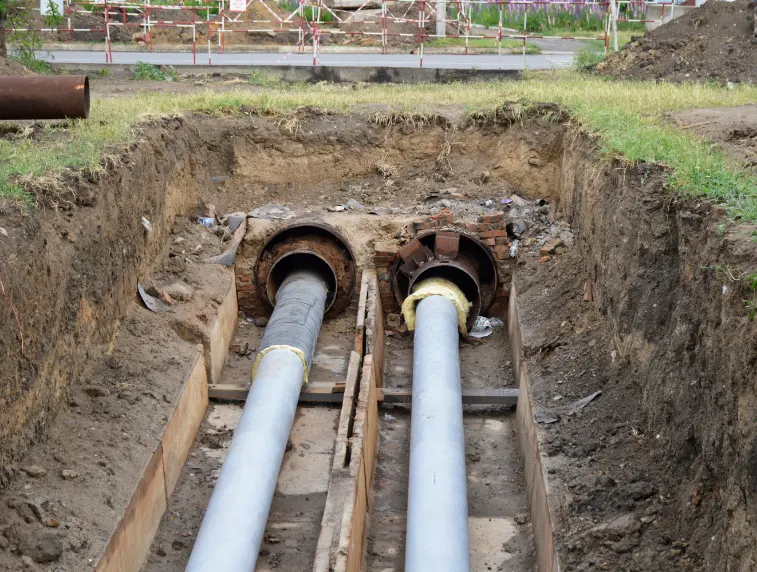
When Should You Book Sewer Line Services?
Not sure what your next step looks like? No problem. Below, we cover when to call for sewer services, how to tell when it’s time for sewer line repair vs. replacement, and what sewer line services cost in the Triangle.
Treat it as an emergency the moment wastewater appears somewhere it should not. Past that, urgency depends on how productive your sewer line still is.
Call the same day if sewage is backing up into a tub, shower, or floor drain, if two or more fixtures have failed together, or if you smell sewage or see standing water in the yard. These symptoms mean the line is either fully blocked or actively leaking, and both can worsen by the hour.
Book within the week if you notice clogs returning weeks after clearing, a toilet gurgling when the washer or tub drains, or sluggish drainage across the whole house rather than one room. None of it is an emergency at this stage, which is exactly why it is worth handling now.
Book sewer line service proactively before closing on a home built prior to 1980, on an older lot where the lateral has never been scoped, and before paving or building over the sewer path. A single slow sink, by contrast, is usually a branch line issue that a rooter service clears in an hour.
One slow drain is a fixture problem; two or more failing at once is a sewer line problem.
Sewage appearing anywhere it shouldn’t is a same-day call.
Who Is Responsible for the Sewer Line in Raleigh, and How Far Should I Clear Blockages?
In Raleigh, the homeowner owns and maintains the sewer lateral from the house to where it meets the City’s main. The City maintains the main itself, plus any break in the street.
Raleigh Water advises asking your plumber to clear a blockage all the way to the City main rather than stopping when flow returns at the fixture, because a partial clearing buys weeks instead of years. Raleigh Water’s sewer service guidance details both sides of that boundary, noting the City pays $50 to whoever first reports a sanitary sewer overflow.
Raleigh homeowners own the sewer lateral from the home to the City main connection, including sections under sidewalks and streets.
Ask any plumber to confirm the blockage was cleared all the way to the City main.
What Are the Warning Signs of a Failing Sewer Line?
Sewer lines rarely fail without notice. The difficulty is that each symptom has an innocent explanation, so they get handled one at a time rather than read together. Here are some of the most common sewer line warning signs to watch for as you maintain your home.
| Warning Sign | What It Usually Means |
|---|---|
| Gurgling toilets, even when other fixtures drain | Air displaced by a partial main line blockage |
| Multiple fixtures backing up together | An obstruction downstream of every branch |
| Sewage smells in the yard or your crawl space | Gas escaping a cracked or separated pipe |
| An unusually green stripe of lawn | The lateral is leaking and fertilizing above itself |
| Soggy ground, depressions, or a sinkhole | Soil washing into a collapsed pipe section |
| Foundation cracks along the sewer path | Long-term saturation undermining the slab |
If you suspect a sewer line failure, time is of the essence when it comes to a fix. We recommend that you book a sewer camera inspection so that you can properly assess and fix the problem.
A green stripe of lawn along the sewer path is a leak signature, not a landscaping win.
Clay soil and tree roots are the two dominant causes of lateral failure in Raleigh.
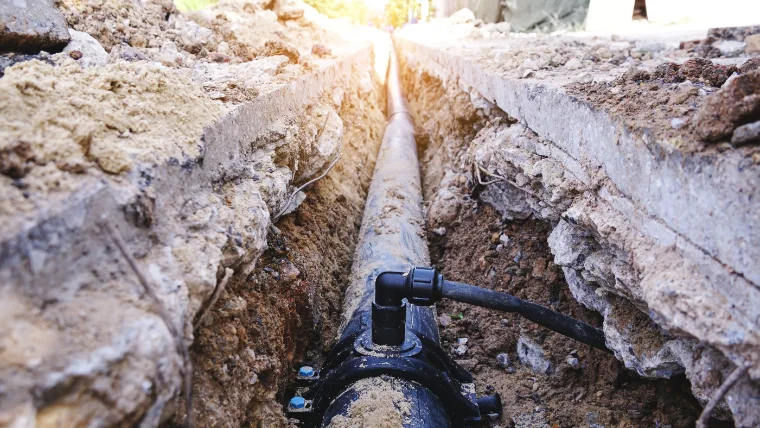
Sewer Line Repair vs. Replacement: How Do You Decide?
The decision is simpler than most quotes make it sound. If the pipe still holds its shape, it can usually be repaired or relined. Once it has collapsed or lost alignment, it has to be replaced.
| Situation | Recommended Service* | Why |
|---|---|---|
| Roots at joints, pipe intact | Relining (CIPP) | A seamless liner closes every root entry point |
| One cracked or offset section of pipe | Spot repair | Cheaper than treating the entire run |
| Grease or scale without pipe damage | Hydrojetting | The issue links back to a cleaning problem, not a structural one |
| Widespread cracking, but a soundly-shaped pipe | Full relining | Relining restores strength without trenching |
| Collapsed, bellied, or Orangeburg pipe | Trenchless replacement | No host pipe remains to line |
| Line that lays under a driveway or mature trees | Pipe bursting | Two access pits instead of a trench |
*All service recommendations are hypothetical only, and are subject to change based on the specific details of a client’s situation. We always recommend that concerned homeowners book an inspection to determine the next right step for their property.
While all these services are valid depending on the specific cause of your concern, we will say that relining is the option most homeowners have never heard of and most often need. A resin-saturated liner is drawn through the damaged lateral and cured in place, forming a seamless pipe inside the old one with roughly fifty years of life.
As with any fix, order of operations matters as much as method. That’s why the camera run comes first, because a replacement quoted without video is a guess; and plenty of lines that look like replacement candidates turn out to be buildup, which resolves with hydrojetting and no excavation.
How Much Do Sewer Line Services Cost in Raleigh?
Clearing a Raleigh main line runs about $175 to $600. A camera inspection lands between $200 and $400 in the Triangle, rising up to $750 on homes without an exterior cleanout.
Hydrojetting averages $466 locally, most jobs between $344 and $589, per Angi’s Raleigh-area cost research.
Structural work is priced by the foot, so length drives the total. Relining typically runs $90 to $250 per linear foot, while trenchless replacement averages $2,848 in Raleigh with most projects landing between $1,866 and $5,892, according to Angi’s Triangle trenchless report.
Clearing a Raleigh main line costs $175 to $600; trenchless replacement averages $2,848.
Lateral length is the largest cost variable.
How Often Should You Schedule Sewer Line Maintenance?
For most Raleigh homes, scoping the lateral every three to five years is enough to stay ahead of trouble. Tighten that to every year or two if the house predates 1980 and still has its original clay tile, or if mature trees stand over the sewer path.
While there is an up-front cost, preventive jetting every two to three years costs less than the emergency it prevents; and routine drain clearing handles ordinary clogs in between.
It’s worth the investment. Contact us today to learn more, or to request your service estimate for preventative maintenance tasks like hydrojetting.
Sewer Line Services FAQs
When should I call a plumber about my sewer line?
You should call a plumber about your sewer line as soon as two or more fixtures drain slowly at the same time, or immediately if sewage appears in a tub, floor drain, or the yard.
Who is responsible for the sewer line in Raleigh, NC?
The homeowner is responsible for the sewer line in Raleigh, at least from the house to the City main connection. This can also include sections beneath a sidewalk or street. The City maintains only the main at the time of this publication.
How do I know if my sewer line is broken or just clogged?
Only a camera inspection distinguishes the two. A clog clears and stays clear; a break produces repeat backups, yard odor, or soggy ground. Contact Streamline Services to request a camera inspection estimate.
Is it cheaper to repair or replace a sewer line?
Repair and relining a sewer line costs less upfront, and are the correct steps to take if the host pipe is holding its shape. Replacement is necessary once a line collapses.
How long does sewer line work take?
Clearing a sewer line takes one to two hours. Relining a sewer line runs one to two days. Trenchless sewer line replacement typically finishes within one to three days.
Does homeowners insurance cover sewer line repair?
Standard homeowners policies typically exclude damage to the buried sewer lateral, and coverage generally requires a separate service line endorsement. Terms vary by carrier and by what caused the damage, so review your own policy or ask your agent if needed.
Get a Free Sewer Line Estimate in Raleigh
Dealing with sewer line issues? We’re here to help. Our company isboth veteran-owned and family-owned across four generations, and holds
thousands of five-star reviews across the Triangle.
We scope the line, show you the footage, and quote the method your pipe
actually needs for your most time- and cost-efficient fix yet.
Call for a free estimate, or read more about our sewer line repair in Raleigh.
Founded in 2001, Streamline Services specializes in plumbing, electrical, heating, and cooling solutions across the Triangle region, including Raleigh, Durham, and Chapel Hill. Under Bob’s leadership, the company has built a reputation for reliability, professionalism, and community engagement. As a licensed contractor, Bob holds North Carolina plumbing license #23908 ensuring that Streamline Services meets the highest industry standards. Beyond his role at Streamline Services, Bob is actively involved in the Plumbing-Heating-Cooling Contractors (PHCC) of North Carolina. He serves as the President of the Triangle Chapter and member of the Board of Directors for North Carolina, where he collaborates with industry peers to promote education, safety, and advocacy within the trade. phccnc.com
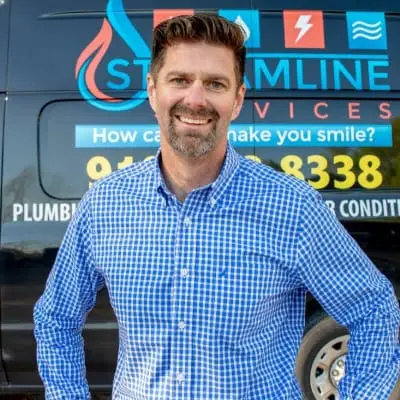
Written by
Bob Sweet
Bob Sweet is the President and Owner of Streamline Services, a fifth-generation, family-owned company based in Durham, North Carolina. Founded in 2001, Streamline Services specializes in plumbing, electrical, heating, and cooling solutions across the Triangle region, including Raleigh, Durham, and Chapel Hill. Under Bob’s leadership, the company has built a reputation for reliability, professionalism, and community engagement. As a licensed contractor, Bob holds North Carolina plumbing license #23908 ensuring that Streamline Services meets the highest industry standards.